https://opusaccounting.ae/bookkeeping-cost-dubai/
https://opusaccounting.ae/bookkeeping-cost-dubai/
Blog Article
Bookkeeping Cost Dubai: Outsourced bookkeeping in Dubai typically costs between AED 500 and AED 5,000 per month for small and mid-sized businesses, with full-service packages covering VAT and corporate tax filing generally landing between AED 1,500 and AED 5,500 per month. Larger, more complex businesses can pay AED check here 8,000 to AED 15,000 or more.
That’s a wide range, and for good reason — bookkeeping isn’t a single, standardised service. Two businesses with similar revenue can have very different bookkeeping needs depending on transaction volume, industry, and how much compliance work sits on top of the core record-keeping.
This guide breaks down what actually drives that range, what should be included at each price point, and how outsourced pricing compares to hiring in-house. For the compliance side of what your bookkeeping needs to support, see our guide to the corporate tax return checklist.
Quick Answer
Basic bookkeeping starts around AED 500 to AED 1,000 per month for very small businesses with low transaction volumes. Most established SMEs pay AED 1,500 to AED 4,500 per month for bookkeeping plus VAT filing. Full-service packages adding corporate tax, payroll, and management reporting typically run AED 2,500 to AED 5,500 per month. Larger or higher-transaction businesses can pay AED 8,000 to AED 15,000-plus.
Why the Range Is So Wide
A first-time buyer of bookkeeping services often assumes price scales cleanly with company size or revenue. In practice, the workload — and therefore the cost — scales with something more specific: how much needs to be recorded, reconciled, and reported each month.
A consultancy with 20 invoices a month and one copyright is genuinely cheap to keep current, regardless of how much revenue those 20 invoices represent.
A retail or trading business with hundreds of transactions, multiple accounts, and inventory tracking costs considerably more, even at similar overall revenue.
This is why comparing quotes purely on business size or revenue, without discussing actual transaction volume, tends to produce misleading comparisons.
How Providers Actually Structure Pricing
Most Dubai bookkeeping providers use one of a few common pricing structures, and knowing which one you’re being quoted helps you compare fairly:
Flat monthly retainer, tiered by transaction volume band — the most common structure, where you’re quoted a fixed fee for up to a certain number of transactions per month, with a higher tier if you exceed it
Per-transaction or per-hour pricing — less common for ongoing bookkeeping, but sometimes used for catch-up work or one-off projects
Bundled packages — a single monthly fee covering bookkeeping plus a defined set of compliance services, often the best value if you need most of what’s bundled
À la carte pricing — bookkeeping quoted separately from VAT filing, payroll, and other services, giving more control but requiring more comparison work to find the real total cost
Typical Pricing by Business Size
Business Type Typical Monthly Range What’s Usually Included
Micro/startup (under 5 staff) AED 500 – 1,500 Basic bookkeeping, low transaction volume
Small business / SME AED 1,500 – 4,500 Bookkeeping, bank reconciliation, VAT filing
Full-service SME package AED 2,500 – 5,500 Bookkeeping, VAT, corporate tax, payroll, management accounts
Larger / complex business AED 5,000 – 15,000+ High transaction volume, multiple entities, CFO-level advisory
These ranges reflect the current Dubai market broadly, not any single provider’s fixed price list — your actual quote depends heavily on the specific factors below.
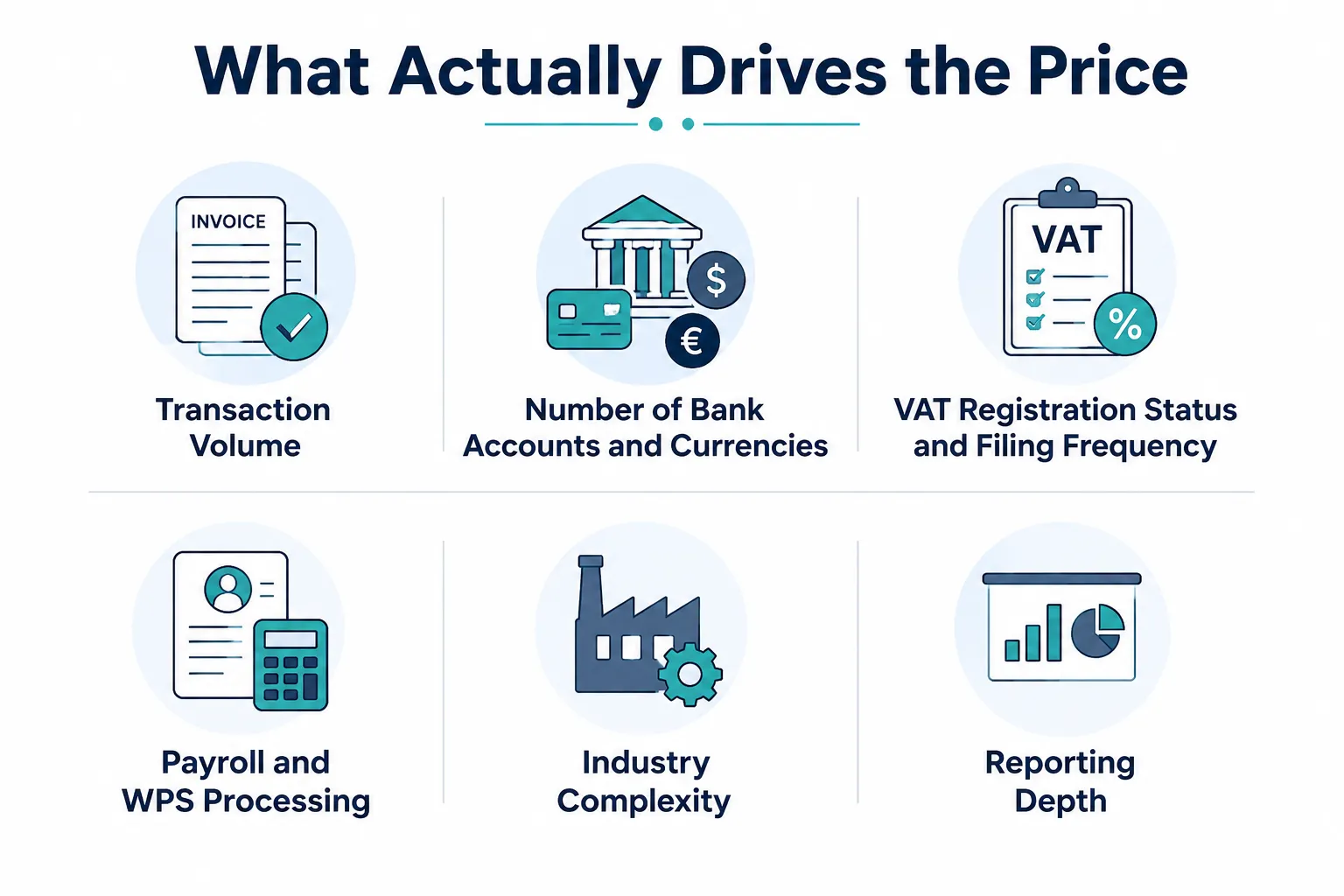
What Actually Drives the Price
What Actually Drives the Price
Two businesses of similar size can pay very different bookkeeping fees. The real cost drivers are worth understanding before you request quotes, since they’re what you should actually be discussing with any provider:
Transaction volume — a business processing 500 invoices a month costs meaningfully more to keep current than one processing 30, regardless of overall revenue
Number of bank accounts and currencies — more accounts to reconcile means more time, and multi-currency transactions add complexity beyond simple AED bookkeeping
VAT registration status and filing frequency — VAT-registered businesses filing quarterly or monthly add a recurring compliance task on top of core bookkeeping
Payroll and WPS processing — adding employees to the scope increases both the workload and the compliance risk being managed
Industry complexity — inventory management, multi-entity structures, or project-based revenue recognition all add time beyond standard transaction processing
Reporting depth — basic bookkeeping (recording transactions) costs less than bookkeeping plus full management reporting (P&L, balance sheet, cash flow analysis)
Of these, transaction volume tends to be the single biggest factor for most small businesses — it’s usually the first question a provider asks, and the main variable that determines which pricing tier you land in.
What Should Be Included at Each Price Point
A cheap quote that excludes core compliance items isn’t actually cheaper once you factor in the risk. A properly scoped bookkeeping package should include:
Monthly transaction recording and categorisation
Bank reconciliation for every account held
VAT return preparation and FTA submission, if VAT-registered
Basic financial statements — profit and loss, balance sheet
Corporate tax return preparation, at minimum for the annual filing
A clear point of contact and response time commitment, not just a mailbox that gets checked periodically
Anything below this baseline isn’t really a discount — it’s a different, incomplete service that will likely need supplementing, at extra cost, once a filing deadline or an FTA query exposes the gap.
In-House vs Outsourced: The Real Cost Comparison
The outsourcing decision usually comes down to this comparison, and the gap is larger than most business owners expect before they run the numbers side by side rather than just looking at salary alone.
Cost Factor In-House Accountant Outsourced Bookkeeping
Monthly salary AED 8,000 – 18,000 Included in package fee
copyright, insurance, gratuity Additional cost, often 20–30% on top of salary Not applicable
Office space and software Additional cost Typically included
Coverage during leave/turnover Gap in coverage Continuous team coverage
Typical all-in monthly cost AED 10,000 – 20,000+ AED 500 – 5,500 for most SMEs
For most small and mid-sized businesses, outsourcing costs 60% to 80% less than a single in-house hire once salary, copyright, insurance, gratuity, and coverage gaps are all accounted for — and it comes with a team’s worth of expertise rather than one person’s, which matters when that one person goes on leave, gets sick, or leaves the company entirely.
When In-House Might Still Make Sense
Very high transaction volume businesses where dedicated, full-time attention genuinely outweighs the cost difference
Businesses needing daily, real-time financial visibility that’s harder to achieve with a periodic outsourced arrangement
Larger organisations that combine bookkeeping with broader finance functions best kept in-house for strategic reasons
Even in these cases, many businesses use a hybrid model — an in-house controller or finance manager supported by outsourced bookkeeping and compliance filing, combining dedicated internal oversight with the cost efficiency of outsourced transaction processing
Hidden Costs Worth Asking About Upfront
Software licensing — some providers include accounting software in the fee, others charge it separately or expect you to hold your own subscription
Onboarding or setup fees — a one-time charge for migrating historical data and setting up your chart of accounts, which some providers waive and others don’t
Catch-up work — if your books are already behind when you engage a provider, bringing them current is usually priced separately from the ongoing monthly fee
Audit support — if your business requires an annual audit, confirm whether liaising with your auditor is included or billed as an extra
Ad hoc reporting — a specific report needed for a bank loan or investor, outside your standard package, may carry its own charge
None of these are necessarily unreasonable charges — but they should be disclosed upfront rather than discovered on an invoice partway through the engagement.
Red Flags in a Suspiciously Cheap Quote
The gap between a compliant service and cheap data entry has become more consequential as the Federal Tax Authority increases its audit activity. Watch for:
A quote significantly below the AED 500–1,500 entry range for anything beyond a genuinely tiny, low-transaction business
VAT and corporate tax filing excluded from the base price without being clearly flagged as a separate add-on
No named point of contact, or a provider unwilling to confirm FTA registration and relevant credentials
Vague scope language — “bookkeeping services” without specifying what’s actually recorded, reconciled, and reported
A missed filing deadline or an incorrect return can cost far more in penalties than the difference between a cheap and a properly scoped bookkeeping package — the cheapest quote isn’t always the lowest total cost.
Which Tier Is Right for Your Business?
Rather than starting from a budget and working backward, it’s usually more useful to start from your actual compliance obligations and let the tier follow:
If you’re not yet VAT-registered and have a small, simple transaction volume, a basic bookkeeping package is likely sufficient for now.
If you’re VAT-registered and filing quarterly, you need at minimum a package that includes VAT preparation and submission, not just transaction recording.
If you have employees, payroll and WPS processing should be either included or clearly scoped as an add-on — this isn’t optional once you have staff on the books.
If you’re approaching the AED 3 million Small Business Relief threshold or expect meaningful growth, it’s worth budgeting for the next tier up before you actually need it, rather than scrambling to upgrade mid-year.
Businesses that under-scope their bookkeeping package to save money in year one often end up paying more overall once catch-up work, corrections, or penalty exposure are factored in.
How to Get an Accurate Quote
Have your approximate monthly transaction count ready — invoices, bills, and bank transactions combined
Know your VAT registration status and filing frequency
Clarify whether payroll and WPS processing need to be included
Ask specifically what’s included versus what’s a separate charge — corporate tax filing, audits, and management reporting are common items that get quoted separately
Compare at least two or three quotes on the same specific scope, rather than comparing headline monthly figures that may cover different services
Report this page